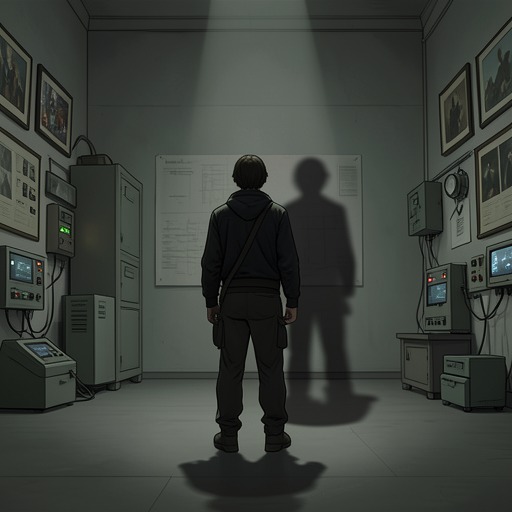
Absurd
Being and NothingnessAbsurdity is the condition in which existence and human projects have no final grounding: contingent existence receives no external justification, while the aspiration to unite free consciousness with absolute being remains unattainable. Sartre’s account connects this condition to consciousness’s outward-directed relation to the world, not to a world hidden inside the mind.
Definition and Scope
The glossary defines the Absurd as that which is meaningless. Human existence is absurd because its contingency has no external justification. Projects are absurd for a related but distinct reason: they aim at an unattainable goal, namely the desire to become God, or to be at once the free For-itself and the absolute In-itself. The term thus describes both the absence of an ultimate warrant for existence and the impossibility of the project that seeks to overcome that absence.
These two dimensions should not be collapsed. Existence is without an external justification; the project fails because its goal cannot be realized. The Absurd therefore does not merely name disappointment with a particular outcome. It marks the mismatch between contingent existence and a goal that would make that existence absolute.
Consciousness and the World
Sartre’s account places consciousness in a relation to what is outside it. As the argument puts it, all consciousness is consciousness of something: a table is not contained in consciousness as an inner representation but exists in space, beside a window, among other things. The table’s inexhaustible reality cannot be inventoried completely; bringing that opacity inside consciousness would turn consciousness into a thing and undermine the cogito. Consciousness instead transcends itself toward its object, and its intentional activity is absorbed in what it posits.
Consciousness is not reducible to knowledge: affective states are also possible. But knowing consciousness must be conscious of itself as knowing its object. This self-awareness establishes that the table exists for consciousness, not that it exists in itself. The distinction prevents the account from treating awareness as a self-contained store of contents, while preserving the difference between an object’s appearance to consciousness and its being in itself.
Being-in-the-World
The account rejects the picture of the For-itself and the world as two closed entities whose connection must later be explained. The For-itself is already a relation to the world; by denying that it is being, consciousness makes a world appear, and by surpassing that negation toward its possibilities it reveals particular things as instrumental. This relation gives the Absurd a concrete setting: consciousness acts amid a world of things, but that engagement supplies no external justification for existence as a whole.
The world appears as an indefinite multiplicity of reciprocal relations, not as a complete view from nowhere that a single consciousness could simply survey. A glass is to the left of a decanter from one position and to the right from another. Likewise, a table leg conceals part of a rug: concealment is not merely a defect in vision but part of how things are related within a world. Such examples show how the world is disclosed through situated relations without being reduced to a mental content or rendered fully transparent. They clarify the setting in which human projects unfold, but do not turn that setting into a final ground for those projects.
The Unattainable Project
The desire to become God names the project of being both free as the For-itself and absolute as the In-itself. The glossary identifies this as a goal toward which projects are directed but which they cannot attain. The ambition is not simply to possess more power or knowledge; it seeks a fusion of freedom with the self-contained absoluteness of being. Sartre’s formulation makes the contradiction decisive: the project tries to hold together modes of existence that cannot be reconciled into a completed ideal.
The concept consequently links the contingency of existence to the structure of action. People project themselves toward ends, and consciousness discloses things in relation to those possibilities, yet no achieved end can supply the missing external justification or realize the absolute ideal. The Absurd is thus both existential and practical: existence lacks a final warrant, while striving toward an ultimate completion remains structurally unsuccessful.